TL;DR
A SaaS landing page is where a paid click lands before a free trial, a freemium signup, or a demo. Pick the motion first, because it sets the CTA, the handoff, and the metric that decides success. Match the page to the ad, hand off to your own signup flow or scheduler with tags and UTMs intact, and judge it on paid CAC and payback, not conversion rate.
The best SaaS landing page for paid traffic sells one next step to the exact person the ad targeted, then hands them off to your product or sales team. Most SaaS landing page examples you’ll find are homepages; Moda’s six recent teardowns all are. The pages SaaS teams actually buy traffic for look different. Housecall Pro runs a trial page per trade, and Deel runs demo pages with prices on them.
Unbounce’s 2024 SaaS conversion benchmark puts the SaaS median at 3.8%, against 6.6% across all industries. But page conversion rate isn’t the number that pays. A variant that lifts signups can still raise CAC if fewer of those signups end up paying.
Below: the three motions, the handoff, the math to a paying customer, live paid examples, and testing.
Key Takeaways
- Pick the motion before the design. Trial, freemium, and demo pages have different CTAs, handoffs, and success metrics.
- The capture step belongs to your product or CRM. Link trials to your own signup flow, embed your scheduler for demos, and put the same tracking tags on both.
- Judge pages on paid CAC and payback. In the illustrative example below, a variant lifts page conversion rate 60% and raises paid CAC 25%, because fewer signups activate.
- Match the page to the ad: one page per keyword group, audience, or vertical, the way Housecall Pro runs a trial page per trade.
- Once volume allows, bid on qualified events (activated trials, held meetings), not raw form fills.
What is a SaaS landing page?
A SaaS landing page is a standalone page built for one audience and one action: start a free trial, create a free account, or book a demo. It’s usually the destination of a paid ad, and its job ends when the visitor reaches your signup flow or your calendar.
SaaS landing page vs homepage
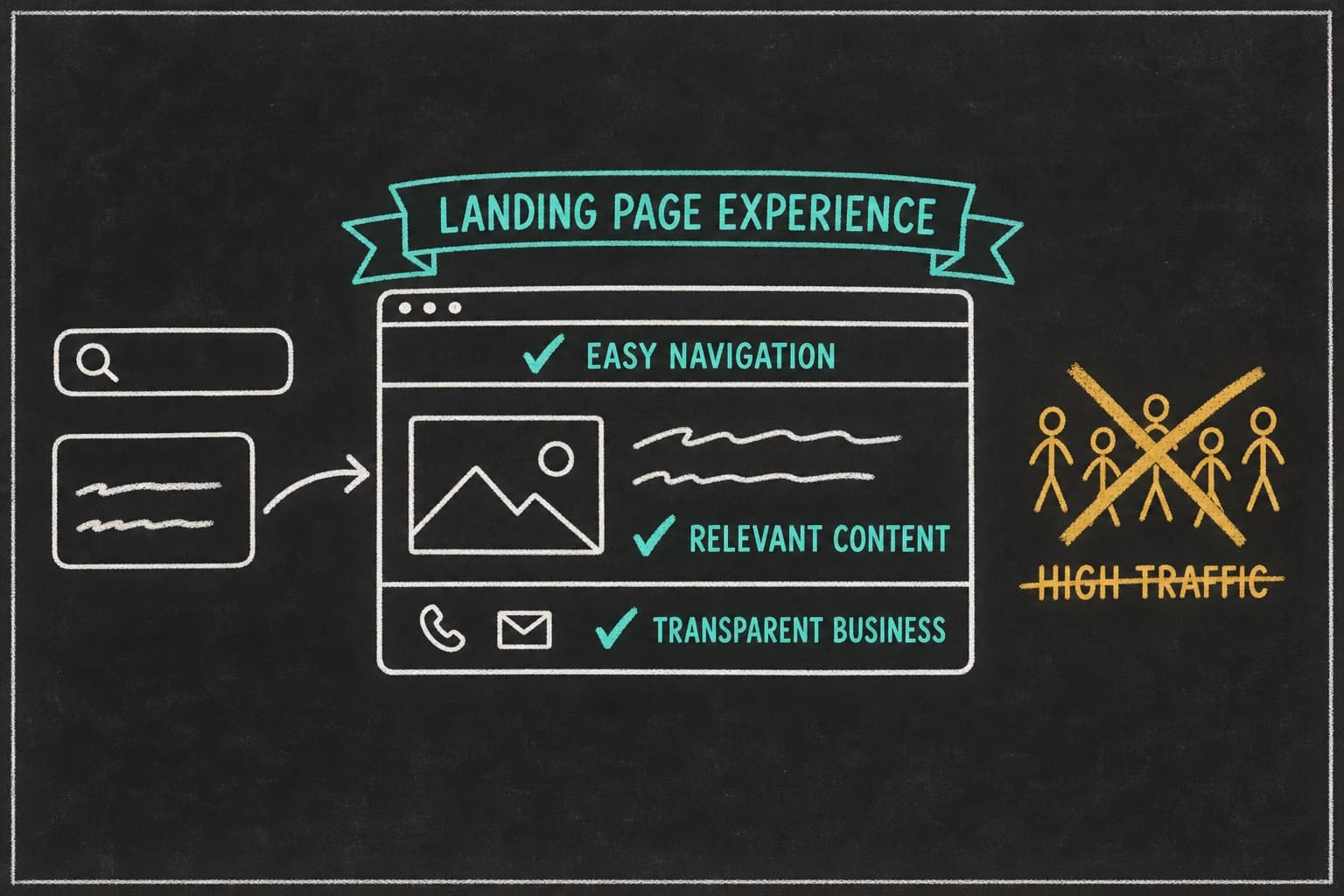
Your homepage serves every segment, plus customers and candidates. A landing page serves one person, arriving from one ad, with one next step.
That’s why paid traffic converts better on a dedicated landing page. A homepage headline describes the company. A landing page headline repeats the ad.
Where the page sits between the ad and the product
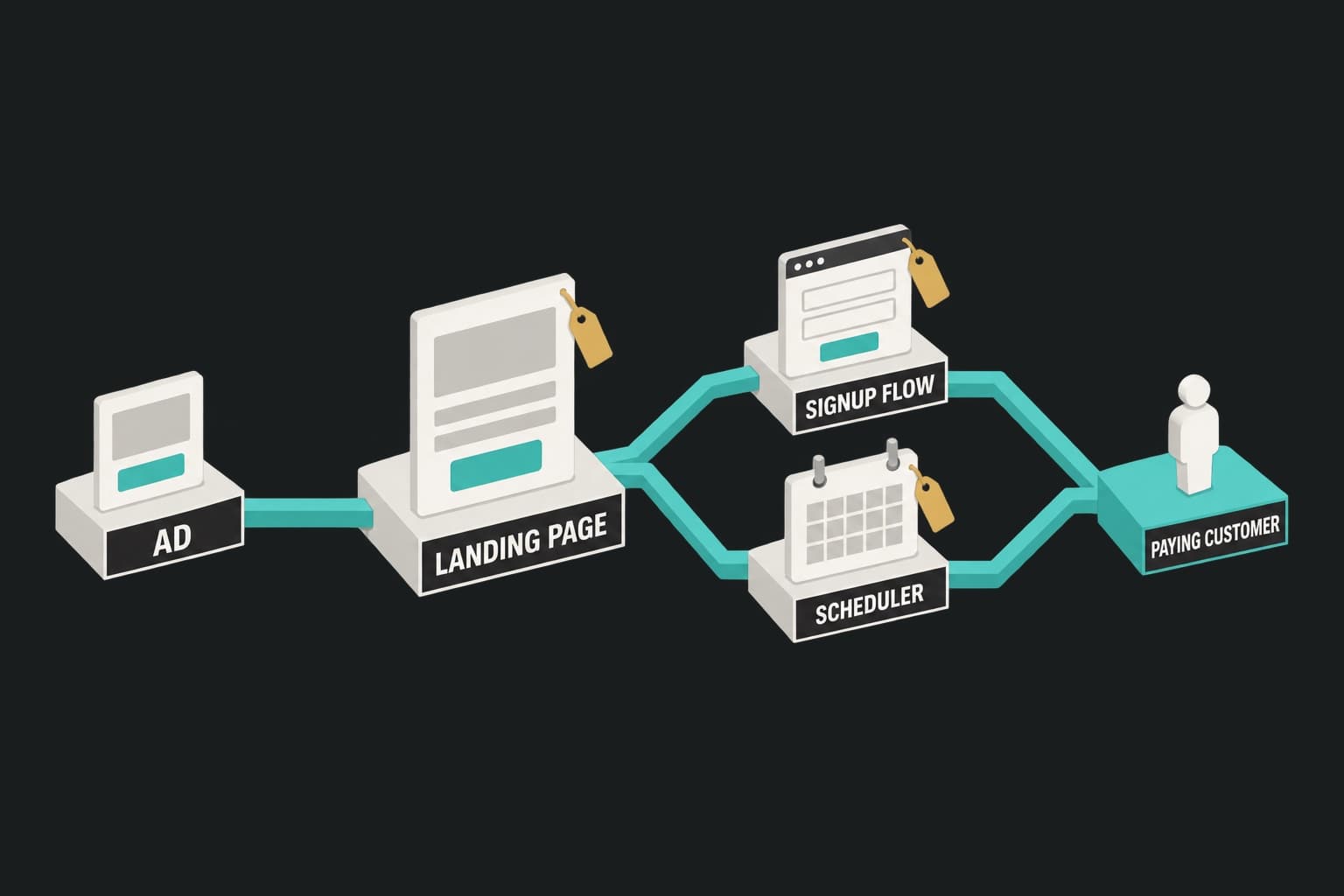
Before the page: the ad and the audience. After it: signup, onboarding, sales. A great page can’t fix a bad first session, and a great trial can’t rescue a confusing page.
Measure the page on the step that matters. Pagedeck counts any event you define as a conversion: a click to your signup URL, a form submit, a booked demo. A/B tests can be judged on that event. See how ad-matched landing pages work.
Pick the motion first: free trial, freemium, or demo
Unbounce’s review of 200 SaaS landing pages found demo and consultation pages made up 55% of the sample, sign-up pages 24%, and lead magnets 21%. It counted the types but didn’t separate their jobs.
| Motion | Primary CTA | What the page must answer | Handoff | Success metric |
|---|---|---|---|---|
| Free trial | Start free trial | What will I get done in session one? | Your app’s signup flow | Activated trials, trial-to-paid |
| Freemium | Sign up free | Why start now, and what stays free? | Your app’s signup flow | Activation, upgrades to paid |
| Demo | Book a demo | Is this worth 30 minutes with sales? | Embedded form or scheduler | Held meetings, closed-won |
Free trial landing pages: the page sells the first session
The visitor trades an email and a password for something done within minutes. Show the product doing that job: the screen and the task.
Answer the SaaS free trial’s terms at the button. Housecall Pro puts “14-day free trial” and “No credit card required” by its CTA. Card-required trials usually start fewer trials with more intent behind each; whether that lowers paid CAC is for your billing data to say.
Freemium signup pages: least friction, weakest intent signal
Freemium removes the deadline and the card, so signups come easier and each one tells you less. Show the free plan’s limits honestly and name the moment someone outgrows it. Judge the page on activation and upgrades, never on signups. A free account nobody uses costs little to serve, but the click that created it cost full price.
Demo request landing pages: the page sells the meeting
A demo page sells 30 minutes with sales to someone who suspects the call will be a pitch. Say who they’ll talk to, what they’ll see, how long it takes, and whether pricing comes up. The visitor can’t try the product first, so put segment logos and review ratings beside the form.
Dual-CTA pages, and when two paths beat one
Some buyers want to click around; others want a guided look. A primary trial CTA with a secondary “book a demo” link serves both, as on GlossGenius’s esthetician page below. Keep one path primary, and track each as its own conversion event.
SaaS landing page best practices for paid traffic
The element-level reasons pages convert are covered in what makes a high-converting landing page. These are the SaaS-specific versions.
Message match: the ad’s promise is the headline
If the ad says “scheduling software for plumbers,” the headline says it too. On Google Search, that means one page per keyword group. On Meta and LinkedIn, one per audience or vertical. Housecall Pro does this by trade.
Take a hypothetical media buyer named Dana, selling field service software on Google Search. Her plumbing, HVAC, and electrical ad groups share one generic trial page. She splits it into three trade pages, each headline echoing its ad group. In this illustrative case, trial starts per click rise on all three, and the HVAC page shows up as the weakest, which blended traffic had hidden.
That’s the job Pagedeck is built for: point it at an ad and it builds a page that continues the pitch, in minutes.
Show the product doing the job
Screens beat illustrations. A short looped clip of the core task, or an interactive tour, answers “what will I do in here?” faster than a feature grid. Keep the copy plain: in Unbounce’s SaaS data, pages written at a 5th to 7th grade reading level converted at 12.9%, against 2.1% for professional-level copy. That’s correlation, not causation.
Proof that matches the buyer
Use logos from the buyer’s segment, review-site ratings, and quotes from someone with the buyer’s job title. “Loved by thousands of teams” loses to one quote from the right role.
Pricing: show it, anchor it, or hold it back
Standard advice hides pricing on demo pages. Deel’s paid landing page for global payroll lists per-employee starting prices next to “Book a demo.” A visible price filters out buyers before they take a sales slot. Show pricing when buying is self-serve, anchor it when deals vary, and hide it only when the call truly sets the price.
Navigation and exits: test the no-nav rule
Unbounce found 91% of the 200 SaaS pages it reviewed had no top navigation. Live paid destinations are messier.
Housecall Pro’s plumbing trial page has a slim header with a login link and a phone number; its electrical contractor page runs the full site menu. Treat “remove the nav” as a test, not a law. Cold visitors who can’t find pricing or reviews on your page may go looking on Google instead.
The handoff: where the conversion actually happens
The capture step belongs to your product or your CRM. The page’s job is to hand the visitor over cleanly.
Trial and freemium: link to your own signup flow
The trial CTA links to your app’s signup, where the account gets created and onboarding starts.
Two things have to survive that handoff. The first is attribution. Pagedeck passes the ad’s UTMs through automatically; check that your signup flow stores them, and any click IDs, on the new account so product analytics and the CRM know which ad it came from.
The second is tags. Tracking tags you add in Pagedeck fire on every Pagedeck page. When the signup flow or scheduler lives on your own app domain, install the same tags there too. Otherwise the completed signup happens where your ad platforms can’t see it.
Demo: embed the form or scheduler you already use
For demos, embed whatever already routes your leads: a HubSpot form, Typeform, Calendly, Chili Piper, or any other embed. Leads land in your CRM and routing fires. Pagedeck doesn’t ship a native form, and for demo pages that’s the right design.
To get ad source into the CRM, HubSpot’s hidden form fields can capture UTM values from the page URL and store them on the contact. Field count, consent, and lead quality decay are covered in the lead gen landing page guide.
When to skip the landing page
LinkedIn Lead Gen Forms and Meta instant forms capture leads without a page: prefilled, easy, and lower intent, because the visitor never sees your landing page. For trials and demos, where the visitor should understand the product first, the page earns its click.
Keep your signup link and your scheduler. Put matched pages in front of them. Point Pagedeck at an ad and let your own signup URL or embed do the capture. Build your first page free, no credit card needed.
The math past the page: CAC from click to paying customer
Activation and trial-to-paid decide CAC. The inputs below are illustrative, not benchmarks: every product defines activation differently, so use your own numbers and follow the chain through the rest of the SaaS trial funnel.
Paid CAC here means media spend divided by new paying customers. Fully loaded CAC adds salaries, tools, and sales time, so treat these figures as floors.
Trial path (illustrative):
| Step | Illustrative input | Result |
|---|---|---|
| Ad clicks | 2,000 clicks at $8 CPC | $16,000 spend |
| Page conversion rate | 5% of clicks | 100 trial signups |
| Activation rate | 40% | 40 activated trials |
| Trial-to-paid (of activated) | 25% | 10 paying customers |
| Paid CAC | $16,000 / 10 | $1,600 |
| CAC payback | $200/month plan at 80% gross margin = $160/month | 10 months |
Demo path (illustrative), same $16,000 spend:
| Step | Illustrative input | Result |
|---|---|---|
| Demo request rate | 4% of 2,000 clicks | 80 requests |
| Meetings held | 60% | 48 held meetings |
| Qualified opportunities | 50% | 24 opportunities |
| Closed-won | 25% | 6 customers |
| Paid CAC | $16,000 / 6 | About $2,667 |
Media cost per held meeting is about $333, and each meeting also costs sales time, so fully loaded CAC sits further above the media figure than on the trial path. The demo motion only pays when the contract is big enough to carry that cost.
Why a higher page conversion rate can raise CAC
Now the trial page gets a variant that drops the product screenshot and leads with “set up in 30 seconds.” It pulls in more curious visitors and loses some serious ones. Same spend:
| Step | Illustrative input | Result |
|---|---|---|
| Page conversion rate | 8% of clicks | 160 trial signups |
| Activation rate | 20% | 32 activated trials |
| Trial-to-paid (of activated) | 25% | 8 paying customers |
| Paid CAC | $16,000 / 8 | $2,000 |
| CAC payback | $160/month gross margin | 12.5 months |
Page conversion rate rose 60%. Paid CAC rose 25%, and payback stretched from 10 months to 12.5. The SaaS landing page variant that wins on the dashboard loses in billing.
Pagedeck can count the signup click or the booked demo as the page’s conversion. It doesn’t see activation, trial-to-paid, or pipeline revenue. Those live in product analytics, the CRM, and billing. Store the UTMs and landing page on each new account to join them back.
Optimize the ad account on qualified events, not form fills
Smart Bidding optimizes toward the conversion actions you mark primary, and Meta toward the ad set’s optimization event. Make that a form fill and they’ll find cheap form fills, so send back a deeper event: an activated trial, a held meeting, a qualified opportunity. Google’s enhanced conversions for leads matches hashed lead data from your form to conversions you later import from the CRM, so bidding learns which clicks became pipeline. On Meta, the equivalent is sending CRM stages back as events through the Conversions API.
Picture a hypothetical demand gen lead, call him Marcus, bidding on demo form submits. Requests climb, but a third of the meetings never happen. He switches the primary conversion to held meetings imported from the CRM, since the account still logs enough of them for bidding to learn. In this illustrative case, requests drop and media cost per held meeting falls.
Channel changes the page
Google Search: keyword-level match, high intent. Unbounce’s SaaS data puts the median for Google search ads traffic at 5.1%, against 0.3% for display: very different traffic temperature. Match the headline to the keyword group and keep the page relevant and fast, since landing page experience is one of the signals Google weighs at auction time.
LinkedIn and Meta: problem-aware traffic needs more explaining. Social traffic saw an ad about a problem, so connect the problem to the product before the ask. On LinkedIn, match proof to the targeted job title and company size. Meta traffic skews mobile, so build for the phone first.
Retargeting and competitor pages. Warm visitors need objection handling or a fair side-by-side, not the product explained from scratch.
B2B landing page examples from live SaaS ad campaigns
The best SaaS landing pages to study are the ones companies pay to send traffic to. These paid-social destinations come from Pagedeck’s research agent, checked live on September 10, 2026. The library indexes pages behind Meta ads, not Google Search or LinkedIn, and no performance numbers are attached. Search the live landing pages behind SaaS companies’ Meta ads.
- Housecall Pro, trade trial pages (trial). The plumbing page opens “Built For Plumbing Service Pros,” and “Start Free Trial” goes to the app’s signup with the 14-day, no-card terms beside it. The electrical page swaps in panel upgrades and EV charger installs.
- Housecall Pro, book a demo (demo). A seven-field form, with “Start Free Trial” still in the slim header for visitors who’d rather self-serve.
- GlossGenius, esthetician page (trial with a demo path). “Build a book that rebooks itself.” Primary “Get started for free,” secondary “Book a demo,” a 14-day no-card trial, and pricing tiers on the page.
- GlossGenius, paid-social demo page (demo). One question before any form: team size, from “Just Me” to “10+.” The answer routes the visitor to the right booking path.
- Deel, global payroll (demo). A
/paid-lp/URL with “Book a demo” as the CTA, per-employee starting prices, and G2 and Trustpilot ratings. - ZoomInfo, GTM platform (demo and trial). The URL carries an
offer=free_trialparameter, and the page pairs a three-field demo form with a free trial path: a self-serve offer for cold social traffic.
Any of these can serve as a SaaS landing page template: Pagedeck can recreate a live page’s structure with your product and copy (see landing page templates).
Testing a SaaS landing page
Test the motion and the offer before the button
The biggest swings come from what you ask for: trial or demo, card or no card, 14 days or 30. Button color comes last. Every Pagedeck page ships with server-side A/B testing, so variants don’t flicker, and a test can be judged on the event you define, such as the signup click or booked demo. The full method is in A/B testing landing pages.
Low volume: size the test first, judge on a downstream metric
Size the test with a free tool such as Evan Miller’s sample size calculator before launch; Pagedeck doesn’t compute significance for you. If the sample won’t arrive in about six weeks, skip the split test.
Take a hypothetical growth marketer, call him Jonah, whose page books 30 demo requests a month. A button test at that volume could take over a year to read. So he runs two ad angles to two pages, one demo-first and one trial-first, and compares cost per held meeting, then paid CAC once a sales cycle closes, reading both as directional. In this illustrative case, the demo-first page records fewer conversions and more paying customers.
One page per ad angle or segment
When tests are slow, ship one matched page per ad angle or segment and compare paid CAC page by page.
Frequently asked questions
What is a SaaS landing page? A standalone page for one audience and one action (start a trial, create a free account, or book a demo), usually the destination of a paid ad.
What makes a good SaaS landing page? It matches the ad, shows the product working, and hands off with tracking intact. The final test is paid CAC.
What is a good SaaS landing page conversion rate? Unbounce’s 2024 benchmark puts the SaaS median at 3.8%, counting both form submissions and clicks as conversions. A 3% page whose signups activate can beat an 8% page whose signups don’t.
Should I offer a free trial or a demo? A trial when the product shows value in one session without help; a demo when setup, data, or a buying committee gets in the way.
Should a SaaS landing page show pricing? Show it when buying is self-serve, and anchor it with a starting price when deals vary, as Deel does on a demo page.
How is a B2B landing page different from a B2C SaaS page? A B2B landing page sells to a buyer who answers to others: segment proof, security and integration answers, often a demo path. B2C SaaS pages run shorter and lead with a trial or freemium.
Conclusion
A SaaS landing page is the page between the ad and the product. Pick the motion, match the page to the ad, and hand off to the signup flow or scheduler you already own, with the same tags and UTMs on both sides. Then judge it past the click: activated trials, held meetings, paid CAC, payback.
Pagedeck is ecommerce-first and works for any business running ads. It builds a page that continues each ad’s pitch, with your signup link or embed doing the capture and server-side A/B tests judged on the event you define.
Build your first page free, no credit card needed, and give every ad group its own matched SaaS landing page.