TL;DR
Advertorial meaning, in one line: paid advertising written and formatted to read like editorial content. As a landing page, the advertorial earns the purchase decision gradually instead of demanding it up front, which is why it converts cold paid traffic better than a product page. It also carries real FTC disclosure obligations and Meta policy exposure, so the format has to be built honestly.
The advertorial is the oldest trick in direct response and still the best page for cold traffic. Print advertisers were running “articles” that sold products a century ago. The format survived every medium since because it does one thing no other page does as well: it lets a stranger talk themselves into a purchase.
Most DTC brands send cold Meta traffic straight to a product page and wonder why cost per acquisition keeps climbing. The product page asks for the decision immediately. The advertorial makes the case first.
This guide covers what an advertorial is, when it wins and when it doesn’t, how to structure one, how to keep it compliant, and how to test it. The compliance section is not a footnote. Read it.
Key Takeaways
- An advertorial is paid content formatted as editorial. On a landing page, it walks cold traffic from problem to mechanism to proof to offer before asking for the sale.
- A dedicated pre-sell page converts cold traffic 2 to 3x better than a product page, according to SplitBase. The advertorial is the pre-sell format for considered purchases.
- The format’s value comes from earning the decision gradually, not from disguising the ad. Fake mastheads, fabricated endorsements, and undisclosed paid content are deceptive under FTC rules and get pages flagged on Meta.
- Most DTC advertorials leak at the handoff: the story builds belief, then the buy box fails to convert it.
- Run one advertorial per ad angle and test the hook first, proof placement second, offer third.
What is an advertorial?
An advertorial is paid advertising written and formatted to read like editorial content: an article, a review, a personal story, or a news feature. The word combines “advertisement” and “editorial.” The advertorial definition that matters for paid media is narrower: a landing page, fed by ads, that presents a product inside a story or an argument rather than a product listing, and ends in an offer.
That’s the advertorial meaning most searchers want. What follows is how to use one.
Advertorial vs listicle vs direct-offer page
| Page | Shape | Traffic temperature | Best for |
|---|---|---|---|
| Direct-offer page | Product, price, incentive, buy box | Warm, retargeting | Products the shopper already understands |
| Listicle | Numbered list, each item an argument | Cold to lukewarm | Category education, quick scan |
| Advertorial | One continuous story or argument | Cold | Considered purchases that need explanation |
The listicle is a subtype of the advertorial: a pre-sell page chopped into numbered items. The advertorial proper makes one long argument. Choose by traffic temperature and by how much explanation the product needs. The listicle landing pages guide covers the sibling format.
The direct-response lineage
The advertorial persists because it’s built on a mechanism, not a trend. Direct-response copywriters figured out decades ago that a reader who understands why a product works will buy it at a higher rate than a reader who’s only been told that it works. The story format gives the copy room to explain the why. Every medium since print, from radio to native ad networks to Meta feeds, has reused it for that reason.
Why advertorials convert cold traffic
Cold traffic clicked out of curiosity. It doesn’t know the brand, hasn’t felt the problem sharply, and has no reason to trust a product page.
The page earns the decision instead of demanding it
A product page opens with the ask: here’s the product, here’s the price, add to cart. For someone who already wants the product, that’s efficient. For someone who doesn’t yet, it’s a wall.
The advertorial reverses the order. It opens on the problem, explains the mechanism, shows proof, and only then presents the offer. By the time the buy box appears, the reader has agreed with three or four things the page said. SplitBase reports that dedicated pre-sell pages convert cold traffic 2 to 3x higher than product pages, and credits advertorial-style pages with a significant role in Hint Water’s paid growth.
Best-fit products
The advertorial works when the product needs explaining and the purchase is considered:
- Supplements with a specific mechanism (an ingredient, a delivery method, a timing claim)
- Skincare with a named active or a distinct routine
- Durable goods that replace an old way of doing something (a countertop composter, a new kind of insole, a smarter cookware set)
- Higher-price items where the shopper needs to justify the spend
When an advertorial is the wrong call
Three cases where it loses:
- Warm traffic and retargeting. The reader knows the product. Send them to the offer.
- Branded search. They typed your name. A product page closes faster.
- Impulse-price products. Under roughly $25, the decision is too small for a 1,200-word story. A direct-offer page wins.
Picture a media buyer, call him Theo, running paid for a $34 cast-iron seasoning kit. He built a 1,500-word advertorial on the history of cast iron and the science of polymerized oil. Beautifully written. It converted worse than the product page. The product was cheap, familiar, and didn’t need a story; it needed a price and a photo.
He rebuilt it as a direct-offer page with a bundle and the cost per purchase dropped by a quarter. The format wasn’t wrong. It was wrong for that product.
The anatomy of an advertorial that converts
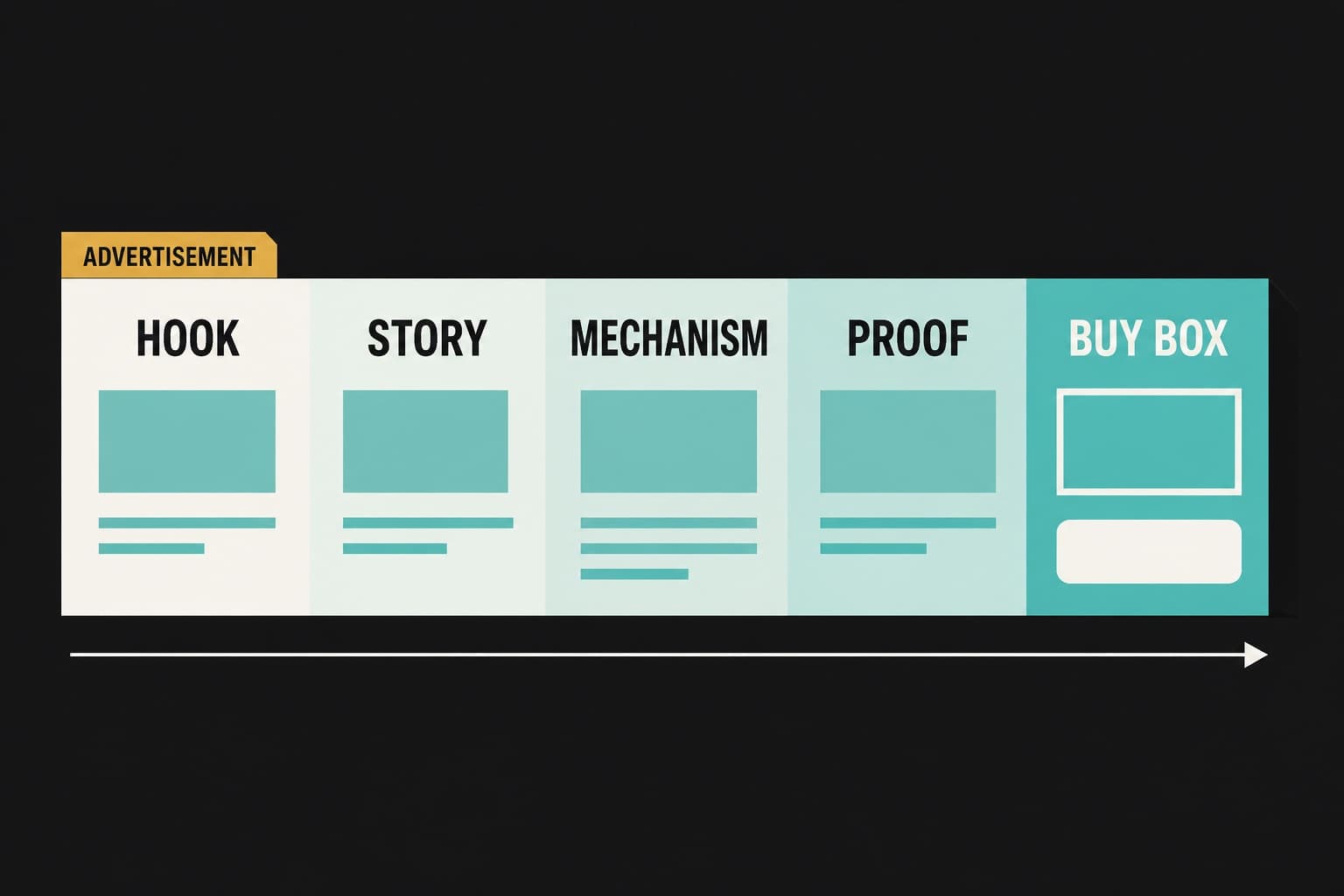
Six blocks, in order. Each one has one job.
The hook: continuing the ad’s promise
The headline and the first paragraph pick up exactly where the ad left off. If the ad said “I tried every sleep supplement for a year,” the page opens with “I tried every sleep supplement for a year.” Not the brand name, not a tagline. The reader clicked a specific promise and the page’s first job is to confirm they’re in the right place.
The story or problem frame
The next 200 to 400 words establish the problem in terms the reader recognizes. A first-person story works for personal products; a category explainer works for durable goods. The frame ends with the reader nodding: yes, that’s my problem too.
The mechanism: why this product solves it
This is the block product pages skip and advertorials exist for. Explain how the product works, specifically. The ingredient and what it does. The material and why it matters. The design decision and the problem it fixes. Cold traffic needs to understand the why before it cares about the what.
Proof at the point of doubt
Proof goes where the objection is, not in a testimonial block at the bottom. A durability claim gets a durability review beside it. A “works in two weeks” claim gets a dated before-and-after beside it, if you can substantiate it (see compliance below). A price objection gets a cost-per-day comparison beside it.
The handoff to the offer
This is where most DTC advertorials leak. The story builds belief for 1,000 words, then the page dumps the reader onto a generic product block that could belong to any page. The handoff is a short transitional section: a one-line summary of the argument, a final proof element, and the offer presented as the natural next step. It should feel like the story’s conclusion, not a jump cut to a store.
The buy box: where AOV is made
The buy box on an advertorial needs everything a DTC buy box needs: unit options, per-unit price at each tier, the discount shown in dollars, the guarantee, and shipping terms. For considered purchases, this is also where bundles, tiered discounts, and subscription defaults earn their keep. The reader has just been convinced; the buy box decides whether they buy one unit or three. Pagedeck builds these mechanics into the page natively, wired to live Shopify product data, so the handoff and the offer are one block rather than a story stapled to a product page.
Want to see advertorials that are getting ad spend right now, with the ads that feed them? They’re broken down by format in landing page examples that convert paid traffic.
Advertorial compliance: the section nobody writes properly
The advertorial format has a real history of abuse. Fake news layouts. Fabricated celebrity endorsements. Before-and-after photos of people who never used the product. “Doctor recommended” with no doctor. Every one of those is deceptive, most of them are illegal, and all of them get pages banned.
If your advertorial only works because the reader thinks it isn’t an ad, you don’t have a landing page. You have a liability.
The format’s value comes from earning the decision gradually. It does not come from disguising the ad. Treat the rules below as the floor.
FTC disclosure requirements for paid content
The FTC’s position is that advertising formatted to look like independent content must be clearly identifiable as advertising. The agency’s native advertising guide for businesses is explicit: a disclosure has to be clear, conspicuous, in plain language (“Advertisement,” “Paid Advertisement,” or “Sponsored Advertising Content,” not “Promoted story” or a bare “Sponsored by [brand],” which the FTC calls ambiguous), and placed where the reader sees it before engaging with the content. A grey “Advertisement” label at the top of the page is the standard. Burying it in a footer is not disclosure.
If the advertorial contains a testimonial, a review, or a first-person story from anyone other than the brand, the Endorsement Guides apply. Endorsers must have actually used the product. Any material connection (payment, free product, affiliate commission) must be disclosed. Results shown must be typical, or the page must say what the typical result is. The 2023 revision tightened all of this, including rules on fake reviews and on using a creator’s image without an actual endorsement.
Meta’s landing page and claims policies
Meta’s Advertising Standards apply to the destination page, not just the ad. The triggers that get advertorials flagged: mimicking a news publisher’s layout or masthead, presenting paid content as independent journalism, making claims on the page that the ad didn’t make, and using sensational or misleading health imagery. A page that reads as an article with the brand’s name visible and a clear disclosure is fine. A page pretending to be a national newspaper is not, and the ad account can go with it.
The before/after trap and health claim risk
Before-and-after images are restricted in Meta ads and scrutinized on landing pages, particularly for weight loss, skin, and body products. Health and outcome claims draw both platform enforcement and FTC attention. The FTC’s Health Products Compliance Guidance sets the standard: claims about health effects need competent and reliable scientific evidence, generally meaning well-designed human clinical testing. “Clinically proven” without the study behind it is a claim you cannot make.
If a line in the advertorial makes a claim you cannot substantiate, cut the line. The page will still convert. The version with the fabricated claim converts slightly better right up until the account is suspended.
What “reads like editorial” is allowed to mean
It means the structure is editorial: a hook, a story, a mechanism, proof, and a conclusion. It means the tone is explanatory rather than promotional.
It does not mean the brand hides. It does not mean the page pretends to be a publication. It does not mean the “author” is a persona who doesn’t exist. The reader can know they’re on an ad and still be persuaded by the argument. That’s the whole point of the format.
Advertorial landing page examples
Four examples, described as ad angle and page response. Where a page structure has been documented publicly, that source is cited; no conversion rate is attached to any named brand.
1. Willow (wearable breast pump). Ad angle: frustration with cord-tethered pumps. Page: a first-person review with pros and cons listed early, walking from the frustration to the product as the resolution, with CTAs at the end of each section rather than in a sticky bar. The early cons are the credibility move. Documented in FERMÀT’s landing page template guide.
2. Hint Water (flavored water). Ad angle: health and sugar habits. Page: a story about soda and sugar, a mechanism section on why flavored water works as a substitute, then the offer. SplitBase credits pages in this style with a significant role in Hint’s paid growth. The mechanism section is the transferable lesson.
3. Lomi (countertop composter). Ad angle: food waste, smell, guilt. Page: a “better way” explainer that walks through the new method with an explicit how-it-works section before the offer. High price, unfamiliar category, so the page makes the mechanism the proof.
4. Gravel (travel toiletry organizer). Ad angle: the mess of packing toiletries. Gravel rethought where its paid traffic went, replacing product-page destinations with dedicated pages matched to each campaign. The brand’s published result: 66% lower cost per conversion on one campaign and 37% lower cost per purchase on another. Read how Gravel cut cost per conversion by 66%. The result is Gravel’s; the mechanism is the destination change.
Testing advertorials
One advertorial gets written, launched, and never touched again. That’s the norm, and it’s the single biggest missed opportunity in the format.
What to test first: hook, then proof placement, then offer
In that order, because that’s the order of impact. The hook decides whether the reader starts. Proof placement decides whether they finish. The offer decides what they buy. Test one at a time. Vary the opening 200 words while holding everything else constant; then move the proof; then change the bundle or the discount framing.
Server-side testing so the page doesn’t flicker on paid traffic
Client-side testing tools run in the browser and swap content after the page starts to render. On an advertorial, that means the reader can watch the headline change. A page whose opening line flickers is a page that just told the reader it’s being manipulated. Run the test server-side so each visitor is served one complete version from the start. Server-side A/B testing is built into every Pagedeck page, unmetered by traffic, for this reason.
Running one advertorial per ad angle
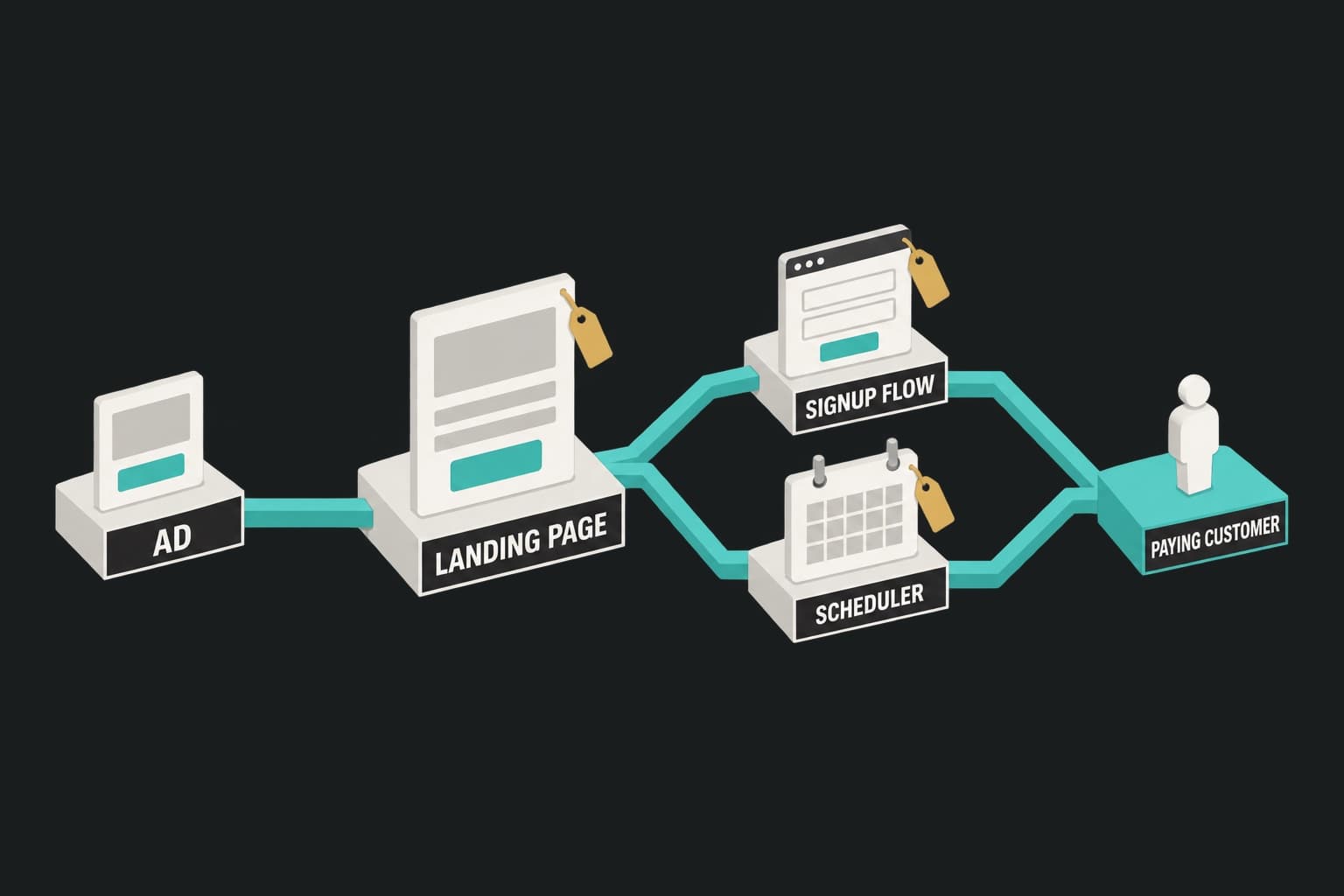
The ad made a specific promise. A “founder story” ad and a “3 signs your gut is off” ad cannot both land on the same advertorial without one of them paying for a mismatch. Build one advertorial per angle. That’s what ad-matched landing pages means: point Pagedeck at the ad, and it picks up the hook, the offer, and the creative, then builds the page that continues that pitch.
A hypothetical to make it concrete. A growth lead named Simone runs a skincare brand with four ad angles live: a founder story, a dermatologist explainer, a “why I switched” UGC piece, and a discount push. All four went to one advertorial written around the founder story. She built a matched page per angle: the derm explainer got a mechanism-heavy advertorial, the UGC ad got a first-person review page, the discount ad got a direct-offer page. Blended cost per purchase fell by a fifth in a month, with nearly all of the improvement coming from the three angles that had been mismatched.
Frequently asked questions
What is the meaning of advertorial? An advertorial is paid advertising formatted to read like editorial content: an article, a review, a story, or a feature. The term blends “advertisement” and “editorial.” On a landing page, it presents a product inside an argument rather than a product listing.
Is an advertorial legal? Yes, when it’s clearly disclosed as advertising and every claim in it is truthful and substantiated. Undisclosed paid content, fabricated endorsements, and unsubstantiated health claims are deceptive under FTC rules regardless of format.
How long should an advertorial landing page be? Long enough to explain the mechanism and place proof at each objection, usually 800 to 1,500 words for DTC products. Shorter than that and the page is a product page with a story headline; longer and it’s an article the reader won’t finish.
Do advertorials work on Facebook ads? Yes, for cold prospecting traffic on considered purchases. They lose to direct-offer pages on retargeting and branded search, and they need clear disclosure and a visible brand to stay within Meta’s policies.
Conclusion
The advertorial converts cold traffic because it earns the decision instead of demanding it: hook, problem, mechanism, proof, handoff, buy box. It’s the right format for considered purchases that need explaining and the wrong one for warm traffic and impulse-price products. Its value comes from the argument, never from disguising the ad, and the FTC and Meta rules on disclosure, endorsements, and health claims are the floor, not a suggestion.
Then treat it as a funnel component, not a one-off. Test the hook, move the proof, change the offer, and build one advertorial per ad angle.
Build your first page free, no credit card needed. Point Pagedeck at the ad and it builds the advertorial that continues the pitch, with the buy box wired in.